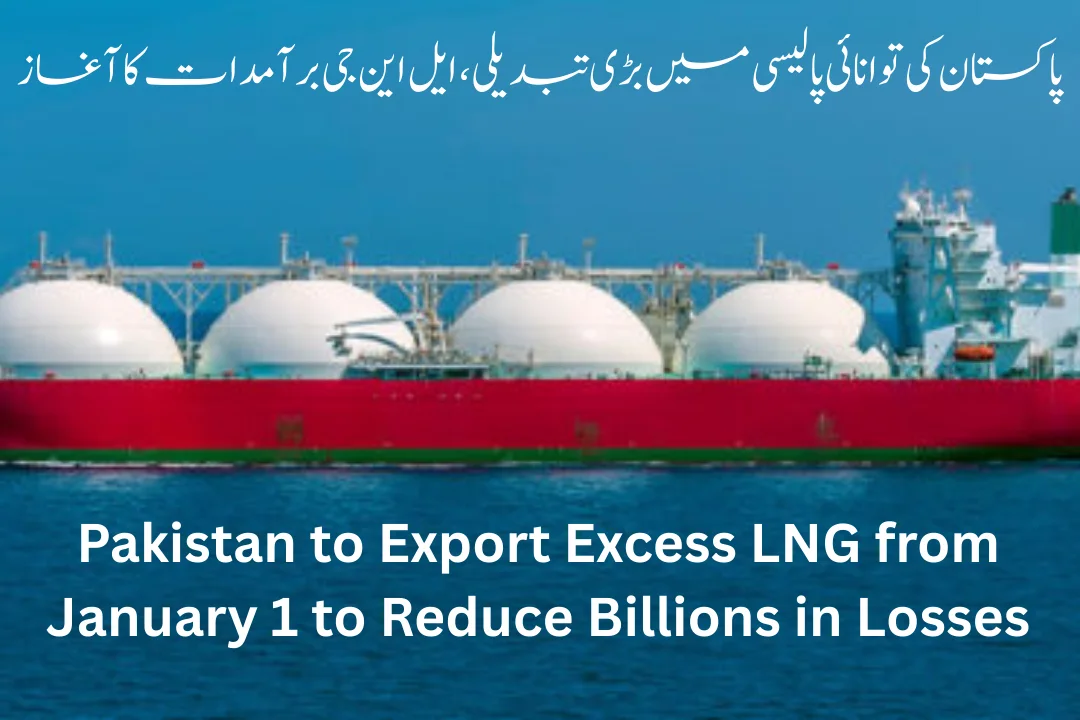
Pakistan to Export Excess LNG from January 1 to Reduce Billions in Losses
Pakistan has announced a major policy shift to sell surplus liquefied natural gas (LNG) in international markets starting January 1 aiming to curb heavy financial losses caused by years of excess fuel imports. Pakistan to Export Excess LNG from January 1 to Reduce Billions in Losses and Petroleum Minister Ali Pervaiz Malik confirmed the move, stating that exporting extra LNG will help reduce nearly Rs1,000 billion ($3.56 billion) in losses accumulated from 2018 to 2019.
Why Pakistan Has Excess LNG
Over the past few months, LNG consumption for power generation has fallen sharply in Pakistan. With international LNG contracts already in place, especially long term agreements with Qatar, the country has been forced to absorb supplies it no longer needs. This mismatch between imports and consumption created a supply glut pushing the government to sell extra gas domestically at a loss and fueling the gas sector’s circular debt.
Earlier reports revealed that the glut was costing domestic producers around $378 million annually while Pakistan had at least three excess LNG cargoes with no immediate local use.
Read more about : SNGPL issue Winter Gas Schedule in Pakistan
Exporting LNG to Ease the Burden
The federal government will now divert surplus LNG to international buyers to minimize financial damage. According to the petroleum minister, exporting excess cargoes will:
- Reduce the growing circular debt in the gas sector
- Limit losses caused by forced domestic sales
- Enable state-owned energy firms to operate at full capacity
- Improve revenues and support job creation
This step will help us reduce losses of Rs1000 billion and stabilize the gas value chain, Malik said, adding that exporting LNG is a practical response to weak local demand and rising fiscal pressure.
Foreign Investors Step
Pakistan’s energy sector is also getting a boost from international partnerships:
Turkey: The Turkish energy minister’s recent visit led to agreements with Turkish Petroleum to begin onshore and offshore drilling in Pakistan. The company will open an office in Islamabad, employing 10 to 15 Turkish professionals initially.
Azerbaijan: A delegation from SOCAR stands for State Oil Company of Azerbaijan Republic is visiting Pakistan to explore collaboration in exploration and infrastructure and SOCAR is set to open a local office and invest millions of dollars in building an oil pipeline from Machike to Thalian in partnership with PSO and FWO.
What This Means for Pakistan
Exporting excess LNG is a timely decision that could:
- Improve cash flows in the energy sector
- Reduce dependence on subsidies
- Strengthen foreign investor confidence
- Help stabilize energy prices in the long run
Combined with fresh foreign investment in exploration and infrastructure, Pakistan’s energy outlook appears to be shifting toward efficiency, diversification and sustainability.
Conclusion
Pakistan to Export Excess LNG from January 1 to Reduce Billions in Losses is taking a crucial step to correct the year of imbalance between imports and consumption. Alongside new foreign investments from Turkey and Azerbaijan the move signals a renewed push to stabilize the energy sector, cut losses and build a stronger foundation for future growth.