
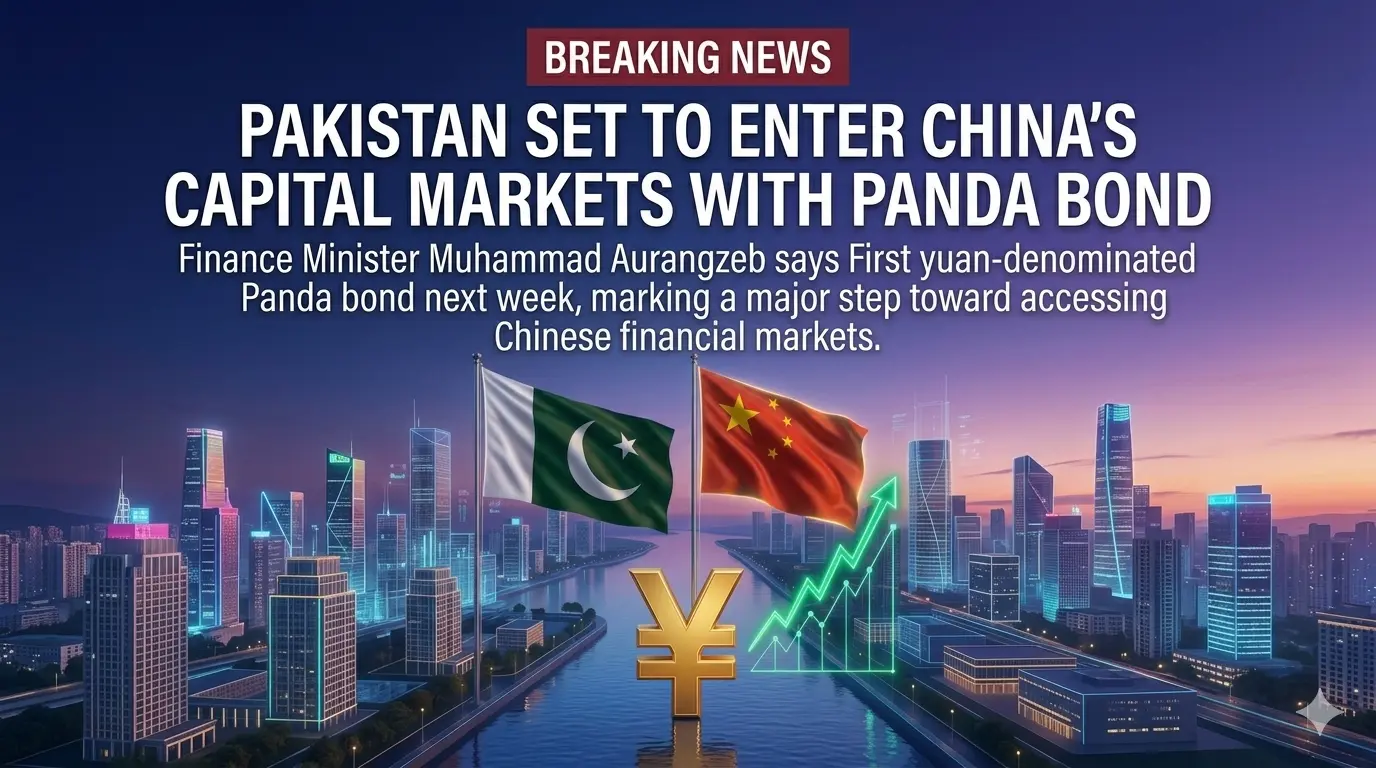
Pakistan Eyes Chinese Capital Market with Panda Bond Debut
Finance Minister Muhammad Aurangzeb travels to Beijing for Pakistan’s inaugural Panda Bond ceremony. The $250m first issuance, backed by ADB and AIIB, marks access to China’s domestic debt market.Finance Minister Muhammad Aurangzeb travels to Beijing for Pakistan’s inaugural Panda Bond ceremony. The $250m first issuance, backed by ADB and AIIB, marks access to China’s domestic debt market.
- First-ever Panda Bond marks Pakistan’s entry into China’s domestic debt market
- $1b programme launched, with $250 million inaugural issuance, aimed at diversifying financing sources and strengthening investor confidence
- ADB and AIIB back issuance, boosting global investor trust in Pakistan
- Aurangzeb to engage investors and highlight economic reforms in Beijing
ISLAMABAD: Federal Minister for Finance and Revenue Muhammad Aurangzeb on Wednesday departed for China to participate in the official issuance ceremony of Pakistan’s inaugural Panda Bond in Beijing, marking a significant milestone as China’s bond market stands among the largest and most developed capital markets globally.
first-ever Panda Bond issuance
According to a statement issued by the Ministry of Finance, the Finance Minister will attend the formal ceremony marking Pakistan’s first-ever Panda Bond issuance, through which Pakistan is gaining direct access to China’s domestic capital market for the first time.
The ceremony will be held at the Pakistan Embassy in Beijing.
The issuance of the Panda Bond represents a key milestone in Pakistan’s financial strategy aimed at diversifying funding sources, strengthening investor confidence, and expanding the country’s footprint in international financial markets.
Pakistan is steadily shifting towards market-based financing alongside traditional funding avenues. Through the Panda Bond, the country will access the Chinese capital market for the first time, reflecting improving macroeconomic indicators and growing investor confidence in Pakistan’s economy.
The overall Panda Bond programme has been set at US$1 billion, while the inaugural issuance will amount to US$250 million equivalent. The issuance is being supported by the Asian Development Bank and the Asian Infrastructure Investment Bank, which is expected to further strengthen international investor confidence

partnership built on mutual trust
Pakistan and China share a long-standing partnership built on mutual trust, strategic cooperation, and strong people-to-people linkages. China has consistently supported Pakistan in difficult economic phases, while initiatives such as the China-Pakistan Economic Corridor have expanded avenues of economic cooperation. The Panda Bond issuance is seen as another step in deepening financial and investment ties between the two countries
During his visit, the Finance Minister is also expected to hold meetings with investors, financial institutions, and senior Chinese officials to discuss bilateral economic cooperation, investment promotion, and future financial collaboration. He will also engage with Chinese media to highlight Pakistan’s economic progress and investment potential
FAQs
What is a Panda Bond?
Panda Bond is a yuan-denominated bond issued by a foreign government or institution in China’s domestic financial market. It allows international borrowers to raise funds from Chinese investors.
Why is Pakistan launching a Panda Bond?
Pakistan aims to diversify its funding sources, strengthen economic ties with China, and access China’s vast capital market for financing development and economic projects.
How will the Panda Bond benefit Pakistan’s economy
The bond could help Pakistan secure lower-cost financing, improve foreign exchange reserves, and attract broader investor confidence in its economy.
Why is the Finance Minister visiting Beijing?
The visit is focused on discussions with Chinese. financial authorities, investors, and institutions regarding the launch process and broader economic cooperation.
What does this move mean for Pakistan-China relations?
The initiative reflects deepening financial and strategic cooperation between the two countries, particularly under expanding economic partnerships.
Are Panda Bonds commonly used by other countries?
Yes, several governments and international institutions have issued Panda Bonds to access Chinese investors and diversify borrowing channels.
Conclusion
Pakistan’s planned entry into China’s capital market through a Panda Bond launch marks a significant step in its financial diplomacy and economic strategy. By tapping into Chinese investors and yuan-based financing, Islamabad is seeking to diversify funding sources while strengthening bilateral economic ties with Beijing. The initiative could open new opportunities for investment, improve market confidence, and support Pakistan’s broader efforts to stabilize and modernize its economy amid evolving global financial dynamics.